
Can a Nurse Practitioner See Patients While Waiting for Insurance Credentialing?
Yes — here's exactly how to do it right, payer by payer, without losing revenue or getting a claim denied.
How long does credentialing actually take?
Credentialing isn't one approval — it's a separate contract with every payer you want to bill, and each one runs on its own clock, its own backlog, and its own paperwork. That's why two NPs who open in the same month can end up six months apart on their first in-network payment.
| Payer type | Typical timeline | What actually drives it |
|---|---|---|
| Medicare (via PECOS) | 60–90 days | Usually the fastest major payer if your application is clean on the first submission. Medicare can backdate coverage up to 30 days from submission in some cases — ask before assuming that window is closed. |
| Medicaid | 30–180+ days | Set entirely by your state. Some state programs clear a file in weeks; others sit for six months. Pull your specific state's current processing estimate rather than trusting a national average. |
| Commercial payers (Aetna, Cigna, UnitedHealthcare, BCBS, etc.) | 90–150 days | Runs almost entirely off your CAQH profile. An incomplete or outdated CAQH attestation is the single most common reason this slips past 120 days. |
| Medicare Advantage / HMO / PPO plans | 90–120 days | Enrolls through the parent payer's network team, so the clock mirrors that payer's underlying commercial or Medicare timeline. |
| Tricare | 90–120 days | Administered through a regional managed-care contractor rather than the government directly — expect commercial-style processing, not government-style. |
Ranges reflect typical 2026 payer processing times reported industry-wide. Your state's Medicaid program and each payer's current backlog are what actually set your number — confirm directly with the payer before you build a launch date around any of this.
What if a payer's panel is closed?
A closed panel isn't a dead end — it's a "not yet."
Payers close panels in a given specialty or region when they feel they have enough in-network providers there. It happens to established practices too, not just new ones — and it isn't permanent.
- Ask directly, in writing, whether the panel is closed or just slow. Some "closed" answers are really a backlog, not an actual freeze.
- Get on the payer's waitlist if one exists, and ask how often they reassess capacity in your area.
- Reapply on a set schedule — every 3 to 6 months — instead of waiting for the payer to reach out. Panels reopen quietly, and being the application sitting on file the day it does matters.
- Ask about a single-case agreement if you already have a patient on that plan who wants to stay with you — some payers will approve one-off in-network rates for an existing patient relationship even with a closed panel.
- Keep your CAQH profile current the whole time. When a panel reopens, the applications that move fastest are the ones with nothing left to fix.
What to actually do while you wait
The practices that lose money during credentialing aren't the ones who wait to open — they're the ones who wait to see patients. You don't have to do that.
- Open on a self-pay basis from day one. Set a clear cash rate and be upfront: "your insurance application with [payer] is in process — here's the self-pay rate until that's approved." Most patients understand this, and plenty will book anyway, knowing you'll be in-network with their plan soon.
- Don't submit claims to a payer while your application is still pending. A claim filed before your effective date usually gets denied outright, and in some cases it slows down the credentialing file itself. Wait for the approval letter and the effective date, then bill that payer going forward.
- Ask about a retroactive effective date before you sign. It's not guaranteed, but some payers — and Medicare specifically, through PECOS — will backdate a window if you ask during contracting instead of after the fact.
Why timelines vary this much between practices
Two NPs can submit in the same week and land three months apart on their effective dates. The difference is almost never luck.
CAQH is the hidden bottleneck
Most commercial payers pull straight from your CAQH ProView profile. Incomplete or expired attestations stall every commercial application sitting behind it — even ones submitted correctly.
State Medicaid rules genuinely differ
Staffing levels, whether the state uses a centralized portal, and how backed up the program is right now move the number far more than anything you do.
One missing document resets the clock
A flagged signature, expired malpractice certificate, or license typo doesn't hold your place in line — the file often drops to the bottom of the queue on resubmission.
How NPWise handles credentialing for you
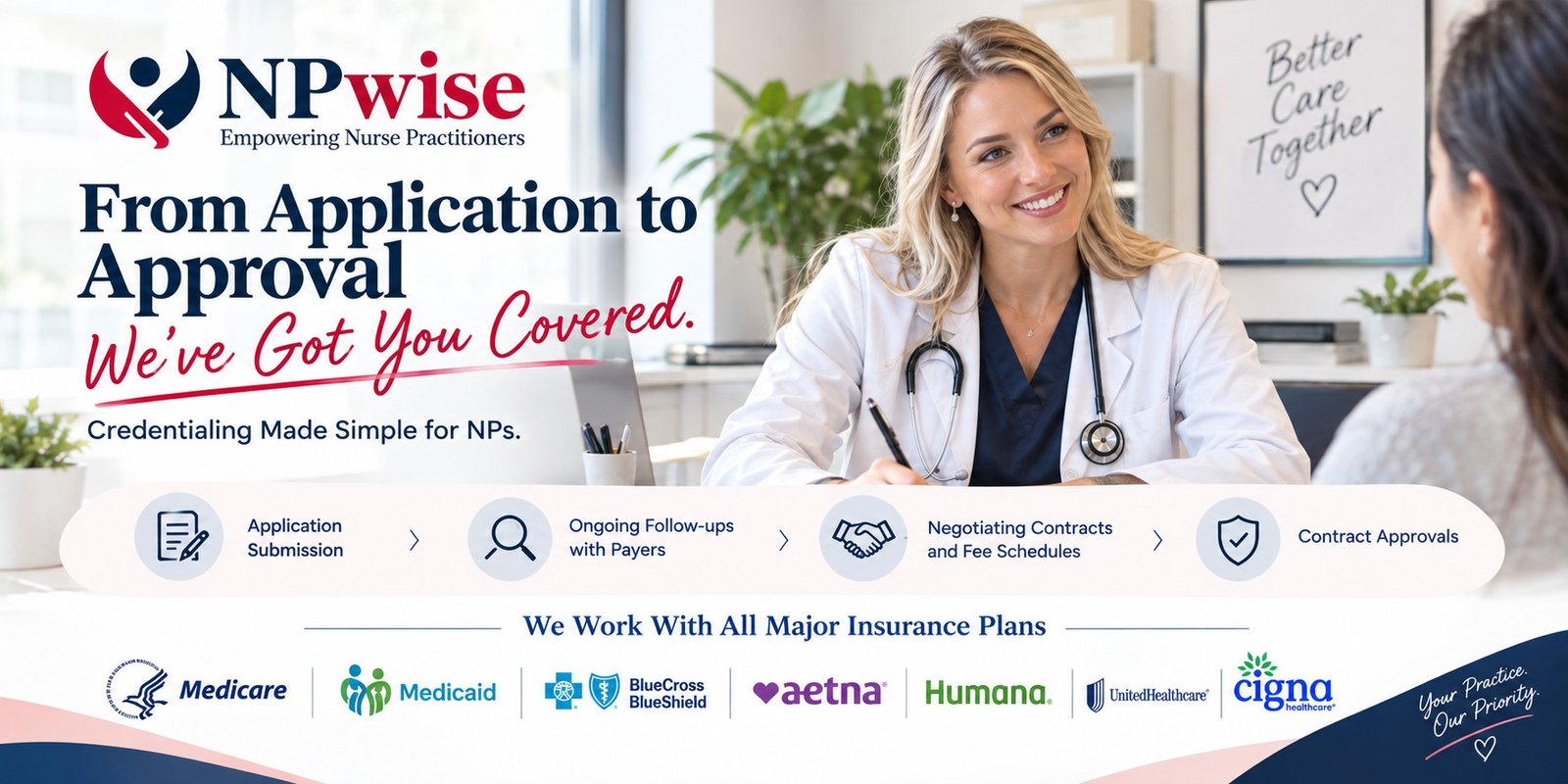
This is the part of opening or growing a practice that eats the most time for the least visible payoff — so it's the part we specialize in. We manage the entire process, payer by payer, so your applications keep moving instead of sitting in a queue:
- Create or update your NPPES and CAQH profiles, and keep the CAQH attestation current
- Prepare and submit applications correctly the first time — Medicare, Medicaid, Medicare Advantage, commercial PPO/HMO plans, and Tricare
- Manage ongoing follow-up with every payer so your file doesn't stall waiting on a document nobody told you about
- Negotiate reimbursement rates and fee schedules where the payer allows it
- Set up direct deposit/EFT once you're approved, so reimbursements land straight in your account — no paper checks to chase down
NPWise Premium Credentialing Plan
We credential you with up to 15 of the major payers in your area under a single flat fee — applications, follow-up, and contract negotiation included. One fee, one point of contact, no per-application math while you're trying to open your doors.
Or pay per application
Frequently asked questions
Can I legally see patients while my credentialing is still pending?
Yes. You can see any patient on a self-pay basis while your applications are in process. What you can't do is bill a payer for visits before your effective date with that specific plan — those claims are typically denied outright.
How long does Medicare credentialing take for a nurse practitioner?
Usually 60–90 days through PECOS, assuming the application is complete on submission. Medicare can sometimes backdate coverage up to 30 days, so it's worth asking rather than assuming the window is already closed.
What does it mean when an insurance panel is closed for nurse practitioners?
It means that payer isn't accepting new in-network providers in your specialty or area right now — usually because they feel they have enough coverage there. It's a pause, not a permanent no, and panels reopen without much public notice.
How do I find out if an insurance panel has reopened?
Reapply on a recurring schedule — every 3 to 6 months — rather than waiting to hear from the payer. Ask your provider relations contact directly how often they reassess network capacity, and keep your CAQH profile current so you're ready to move the moment a spot opens.
Is Medicaid credentialing the same in every state?
No. Medicaid is administered at the state level, and processing time ranges from about a month to six months or more depending on the state's system and current backlog. Always check your specific state's current timeline rather than relying on a national number.
Once I'm approved, can I bill for visits from before my effective date?
Generally no for commercial payers — your effective date is the line, not the approval call. Medicare is the exception, where limited backdating is sometimes available if requested during enrollment.
Do I need a CAQH profile if I only plan to bill Medicare?
Medicare itself doesn't pull from CAQH, but almost every commercial payer and many Medicaid managed-care plans do. If there's any chance you'll add commercial or MCO contracts later, it's worth setting CAQH up correctly from the start rather than scrambling for it later.
How much does nurse practitioner insurance credentialing cost?
Doing it yourself costs your time, mostly — but if you'd rather outsource it, NPWise charges $149 per private insurance application, $179 per government payer application, or $2,399 for a one-time, all-inclusive plan covering up to 15 major payers in your area plus contract negotiation.
This isn't just paperwork.
It's your path to in-network. We know how to get you there.
Credentialing is usually the first real wall between you and a full patient panel — not the paperwork itself, but everything it quietly steals from your first year in business: hours spent chasing payer emails, resubmitting flagged documents, and keeping a CAQH profile from going stale. Hand it to NPWise and it stops being your problem. We submit every application, follow up with every payer, and stay on it until you're approved — so while you're focused on running your practice, your referrals are turning into paid, in-network visits instead of ones you have to put off.
Start Your CredentialingPrefer to talk it through first? Reach us directly — info@npwise.org · 718-413-0431
Empowering Nurse Practitioners: Your Autonomy, Our Mission.