
Stop Leaving RPM Revenue on the Table
RPM Billing for Nurse Practitioners: The Complete 2026 Guide to CPT 99453–99458
How to bill Remote Patient Monitoring correctly, who qualifies, what each code pays, and how a 100-patient panel can add six figures in recurring revenue.
Jump to a Section
If you've got a panel of patients with hypertension, diabetes, or obesity, you're probably already telling them to "keep an eye on your blood pressure at home." RPM is the billing structure that turns that advice into a documented, reimbursable service — instead of unpaid work you're already doing informally.
What Is Remote Patient Monitoring (RPM)?
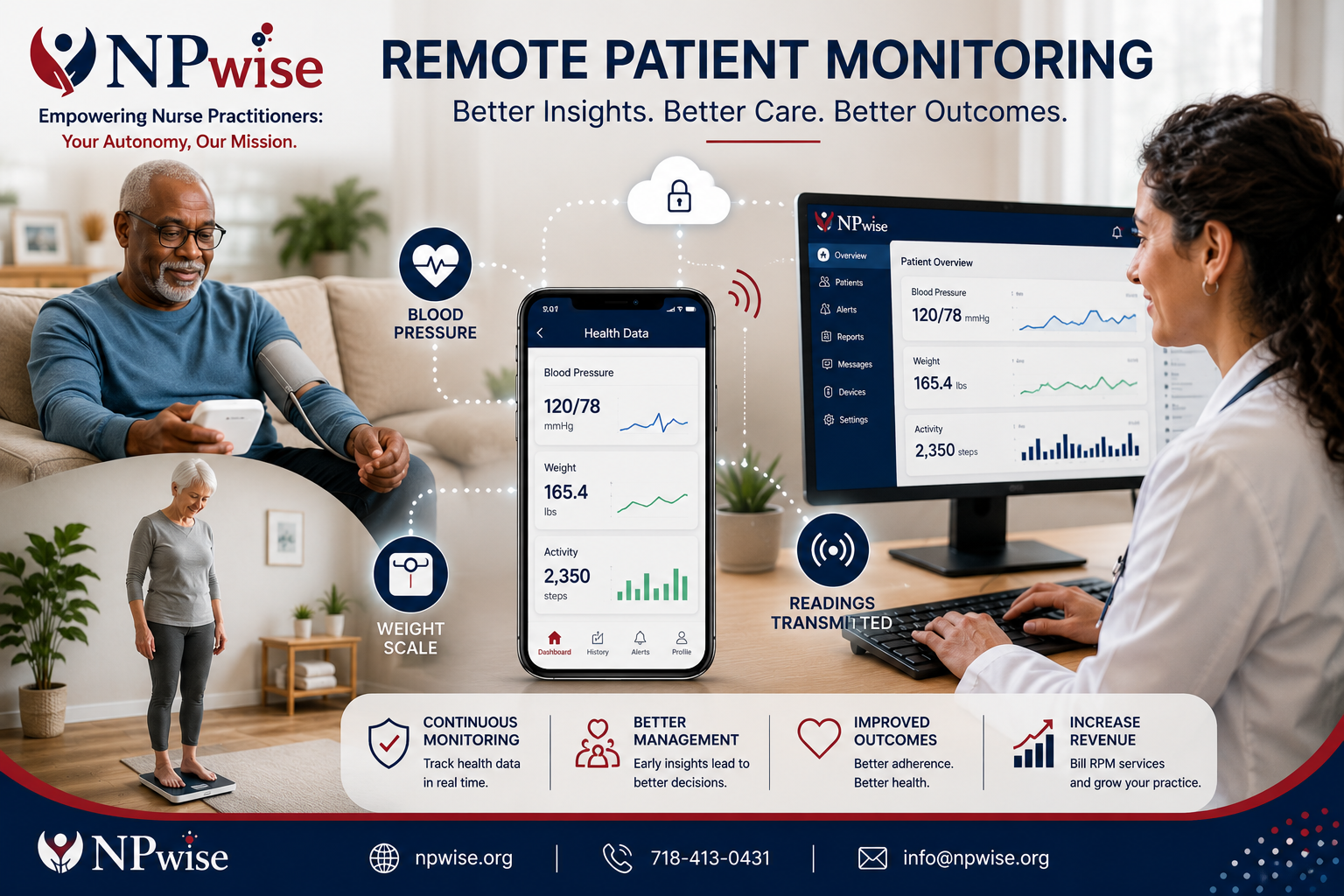
Remote Patient Monitoring is the collection and clinical review of a patient's physiologic data — blood pressure, weight, blood glucose, pulse oximetry — using an FDA-cleared connected device that automatically transmits readings to your practice. Medicare (and most commercial payers) reimburse RPM under a defined set of CPT codes, separate from an office visit. It is not a wellness perk; it's a billable clinical service with its own documentation rules.
Which Patients Qualify for RPM?
Per CMS's own coverage guidance, a patient is eligible for RPM if they have a chronic condition that requires ongoing monitoring of vitals to manage a treatment plan. There's no restrictive diagnosis list — but the readings being tracked need to tie back to a real, medically necessary reason. Most NP panels already have dozens of candidates:
- Hypertension (BP cuff)
- Type 2 diabetes (glucose meter)
- Obesity / weight management (scale)
- Heart failure / cardiac conditions (weight + BP)
- COPD / chronic respiratory conditions (pulse oximeter)
- Chronic kidney disease
- Chronic pain or post-surgical recovery
- Only one practicing provider can bill RPM for a given patient in any 30-day period. A patient can still see other providers, but they can only be actively enrolled in a billed RPM program with one practice at a time.
- The patient must know they're enrolled and must consent (verbal consent is acceptable, but it needs to be documented in the chart) — and be told they're responsible for any applicable copay or deductible.
Enrollment can happen during an office visit or at any other point of contact — it doesn't require a dedicated visit type. For new patients, or patients the billing provider hasn't seen in the past year, CMS generally expects RPM to be initiated around a face-to-face visit (billed separately), though this isn't a hard requirement in the fee schedule.
How an RPM Program Actually Runs
- Enroll and inform the patient. Document consent, explain the program, and confirm they aren't already enrolled in RPM elsewhere.
- Supply the device. An FDA-cleared, cellular-enabled BP cuff, scale, glucose meter, or pulse oximeter — no manual entry. Readings transmit automatically; the patient doesn't log anything themselves.
- Patient takes readings at home. Data flows straight to your monitoring dashboard.
- Clinical staff or you review the readings and trends, and document the time spent reviewing (this is what builds toward your 20-minute, then 40-minute, monthly total).
- Have one interactive, two-way communication with the patient each month — a phone call, video check-in, or secure message exchange about a flagged reading. It doesn't need to be long; even a brief 1–10 minute exchange satisfies the requirement, as long as it happens and is documented (date, method, and a short memo of what was discussed).
- Bill monthly once your time and transmission-day thresholds are met.
You can run this through a third-party RPM vendor that supplies the devices and the receiving/monitoring system as part of their service, or set it up yourself with a platform capable of receiving and organizing the transmitted readings — that's typically a one-time technical setup on your end either way.
The RPM CPT Codes: What Each One Covers and Pays
| CPT Code | What It Covers | Requirement | 2026 Avg. Reimbursement* |
|---|---|---|---|
| 99453 | Initial setup & patient education on the device | One-time, billed once per episode of care | ~$19–22 |
| 99454 | Device supply with daily recording/transmission | 16+ days of transmitted data in a rolling 30-day period | ~$47–53 |
| 99457 | First 20 minutes of clinical staff/NP treatment management time | ≥20 minutes/month + one live, two-way interactive communication (any length) | ~$48–52 |
| 99458 | Each additional 20 minutes beyond the first 20 (add-on) | Can be billed more than once/month once documented | ~$41–52 each |
*National non-facility averages; actual payment varies by locality, MAC, and whether the payer is Medicare, Medicaid, or commercial. Always confirm against the current Medicare Physician Fee Schedule for your area.
- 99453 is billed once per episode of care — a one-time setup fee, not repeated monthly.
- 99454 runs on a rolling 30-day period — it's billed once you've collected 16 days of readings within that 30-day window, not tied to the calendar month.
- 99457 and 99458 are calendar-month codes — if you bill them in February, the clock resets and you bill them again in March, and so on each month.
In practice, most practices bill everything together on the last day of the month (for example, March 30th or 31st) — submitting 99454 alongside that month's 99457/99458 on the same date, once each code's requirements are met.
What RPM Can Actually Add to Your Revenue
This is the number most NPs never sit down and calculate. Using standard national-average rates, here's a realistic baseline (99454 + 99457) versus a fully optimized month (adding one 99458 block of additional time):
| Enrolled Patients | Baseline (99454+99457, ~$100/mo) | Fully Optimized (+ 99458, ~$150/mo) |
|---|---|---|
| 50 patients | ~$5,000/month | ~$7,500/month |
| 100 patients | ~$10,000/month | ~$15,000/month |
| 150 patients | ~$15,000/month | ~$22,500/month |
Monthly Recurring RPM Revenue by Panel Size
Where a Fully Optimized ~$150/Patient/Month Comes From
- 99454 — device supply, ~$47
- 99457 — first 20 min, ~$52
- 99458 — additional 20 min, ~$51
99453 setup (~$20) is one-time at enrollment and not included in this recurring monthly view.
That's recurring monthly revenue on top of your existing visit-based billing — generated from patients you're already managing for chronic conditions. It's one of the few services in NP-led practice that scales with staff time rather than provider face-to-face hours.
Compliance: Where Practices Lose This Revenue
The most common audit triggers:
- Billing 99457 without a documented memo of the interactive communication — date, method (phone, video, secure message), and a short note on what was discussed
- Billing 99454 more than once per patient per 30 days, even with multiple devices
- Counting patient self-reported readings instead of automatic device transmission
- Reusing the same office-visit note as RPM documentation — RPM time needs its own separate note, distinct from any E/M visit note for that patient
- Billing RPM and Chronic Care Management (99490) in the same month using the same minutes — each program needs its own documentation template, and the time behind each can't overlap
- Enrolling patients without documented consent, or enrolling a patient already billing RPM through another practice
Build in a task-based care plan review for each RPM patient every 3–6 months (or per your payer's requirement) — it keeps the clinical rationale current and gives you a clean audit trail showing the monitoring is still medically necessary.
Fast Answers
Can a nurse practitioner bill RPM codes directly?
Yes. NPs can order and bill RPM under their own NPI as the billing provider, and the day-to-day monitoring time (99457/99458) can be performed by clinical staff under general supervision.
How many days of data do I need before billing 99454?
At least 16 days of transmitted readings within a rolling 30-day period. Fewer days (2–15) now falls under the new 99445 code instead.
Who supplies the RPM device — the practice or the patient?
The practice supplies the FDA-cleared, cellular-enabled device (directly or through an RPM vendor). Patient-owned consumer devices generally don't meet billing requirements.
Can RPM be billed with Chronic Care Management (CCM)?
Yes, in the same month, as long as the time and documentation for each program are kept separate and don't overlap.
Can a patient be enrolled in RPM with two different practices?
No. Only one practitioner can bill RPM for a given patient in a 30-day period, so RPM enrollment itself is exclusive to one practice at a time.
Go Deeper
Not sure if you're capturing everything you're owed on RPM?
If RPM billing feels like one more thing you don't have bandwidth to get right, you're not alone — and you don't have to figure it out solo.
NPWise's billing team can manage your RPM coding and claims from enrollment through payment, built specifically for nurse-practitioner-led practices.
info@npwise.org | 718-413-0431 | 30 N. Gould St, Suite 4000, Sheridan, WY 82801