
The 10 states to license in first as an NP — and the data behind why
A license fee is a cost you pay once. Patient demand and practice authority are things that follow you every month you hold that license. Here's what the federal shortage data, state boards, and practice-authority rules actually say about where the opportunity is.
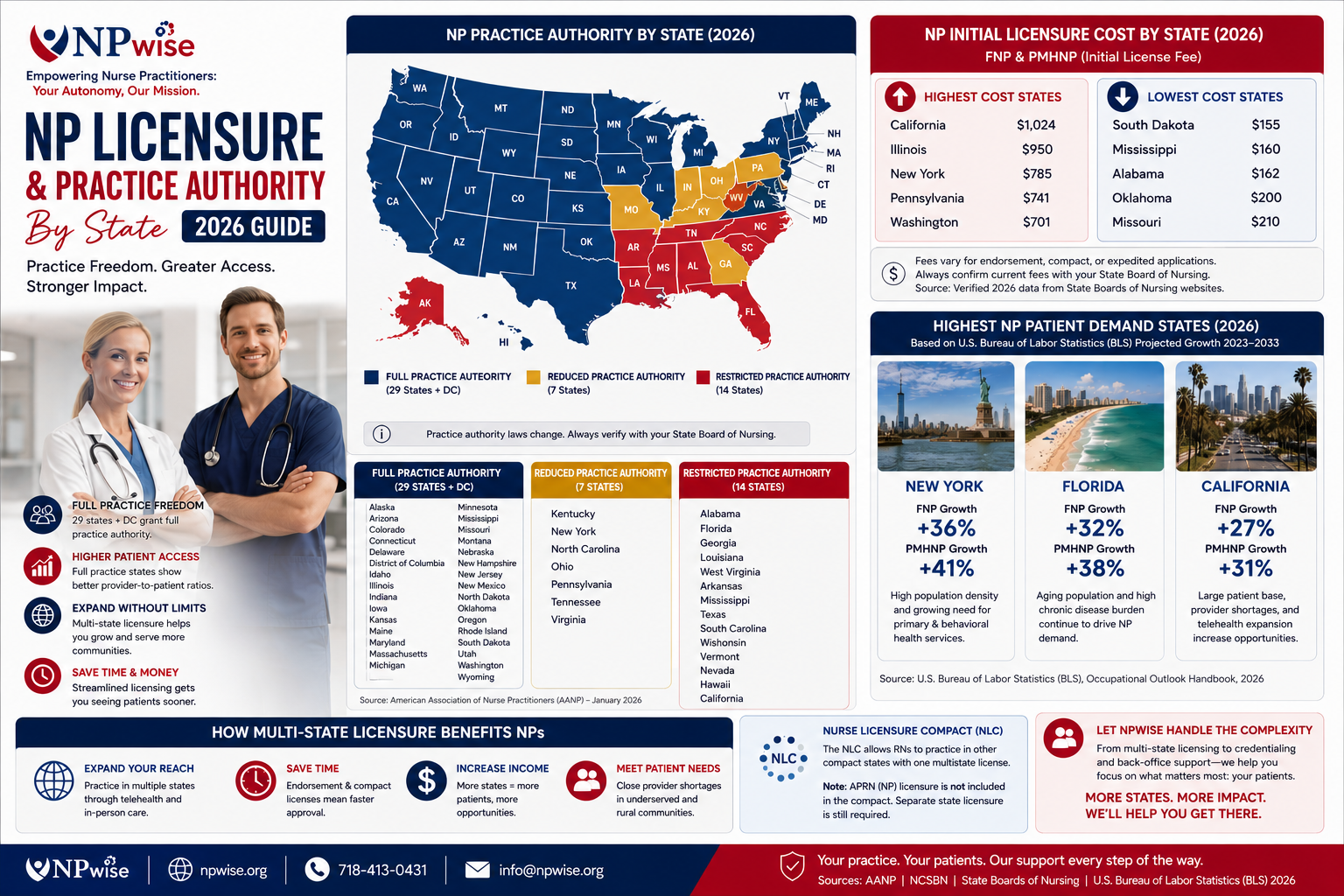
If you're building a multi-state licensing strategy, the fee shouldn't be what decides your order. A cheap application in a state with low demand doesn't do much for your panel, your income, or your telehealth reach. The states below are the ones where the underlying numbers — provider shortages, population, and how much independence you get as an NP — actually justify going first.
The 10 states, and the reasoning behind each
Five states make this list because of sheer patient demand: large populations, high shortage numbers, or an aging patient base that needs primary care now. The other five make it because of full practice authority — you can see patients there without a collaborating physician. That doesn't mean those five have no demand; it means independence is the deciding factor on top of demand that's already real.
| State | Why it's on the list | Need met | Still needed |
|---|---|---|---|
| California | Demand Largest NP market, strongest rates | 53.6% | 1,045 |
| New York | Demand 34,000+ NPs already practicing | 35.4% | 1,036 |
| Texas | Demand Raw population and patient volume | 51.0% | 1,147 |
| Florida | Demand Large aging population, heavy Medicare base | 39.6% | 1,434 |
| Georgia | Demand Underserved outside metro Atlanta | 39.0% | 563 |
| Arizona | Full Practice No collaborating physician required | 42.2% | 776 |
| Washington | Full Practice Telehealth-friendly, independent | 45.4% | 685 |
| Colorado | Full Practice Urban + rural demand mix | 46.7% | 171 |
| Oregon | Full Practice Long-established independence | 51.3% | 169 |
| New Mexico | Full Practice Real underserved-area demand | 43.7% | 182 |
"Need met" and "still needed" are from HRSA's Q1 FY2026 Designated Health Professional Shortage Area report (data as of 12/31/2025). This metric counts physicians only — it doesn't credit NPs already closing part of the gap, which understates the real opportunity for NPs willing to practice in these states.
What the shortage numbers actually show
None of these ten states clear 54% of primary care need met. Nationally, the states doing the best job meeting demand — Vermont at 84%, New Hampshire at 79% — aren't exactly overflowing with room for a new NP building a panel from scratch. The states with the biggest gaps and the states with the most opportunity are, very often, the same states.
Beyond the panel: what this does for jobs and telehealth
Patient acquisition is one side of this. The other is what a spread of active licenses does for you professionally, whether you stay independent or not:
- Telehealth panel size. You need an active license in whatever state your patient is physically in at the time of the visit. Every additional state is a state's worth of telehealth patients you can legally see.
- Remote-employer eligibility. Telehealth companies and staffing platforms filter candidates by which states they're already licensed in. Five to ten licenses puts you in a meaningfully wider applicant pool than one.
- Insulation from any one state's politics. New York's independent-practice framework was on track to expire this July and only got extended after a late legislative push. A spread of licenses means your career isn't riding on one legislature's session.
"Boards move at the pace of your paperwork, not the other way around."
Processing timelines commonly run a few weeks to a few months depending on the state and how complete your application is. Have transcripts, RN license verification, national certification, malpractice history, and — in collaborative-practice states — a signed practice agreement ready before you file. Nothing else shortens the timeline the way a complete file does.
We handle the paperwork. You keep the panel.
Application prep, submission, and ongoing follow-up with the board until you're approved — with no charge if you're not. You'll still handle anything that legally requires you in person, like fingerprinting or biometric verification. Everything else is ours.
HRSA Bureau of Health Workforce, Designated HPSA Quarterly Summary, data as of 12/31/2025
Becker's Hospital Review, "Primary care provider gaps, ranked by state," Jan. 15, 2026
AANP, State Practice Environment
MCCM Law, "New York Extends Independent Practice Authority for Nurse Practitioners Through 2030" (2026)
GetLicenseMap, 50-State Nurse Practitioner Licensing Comparison, verified March 2026